The story
A stone twice revised
In London in the mid-1870s, a single carat of tiger’s eye cost about twenty-five shillings. The stone was scarce, its origin obscure, and jewellers treated it as a precious gem. Then, in the 1880s, the vast deposits of Griqualand West in South Africa’s Northern Cape were opened, and the price collapsed within a generation. By 1900 the trade had quietly reclassified it as semiprecious. Nothing about the stone had changed; only what was known of it.
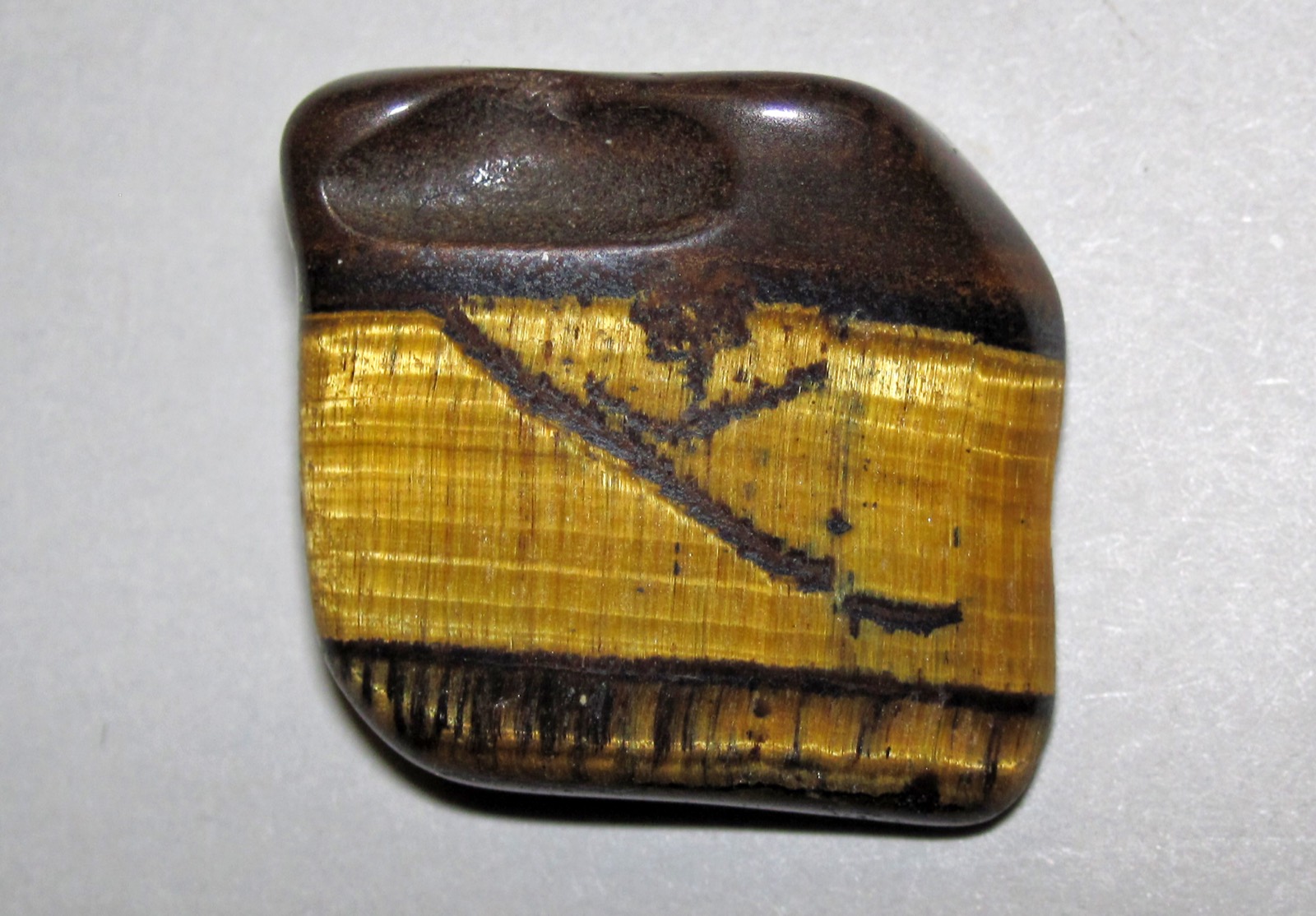
The science took longer to correct itself. From 1873, mineralogy held that tiger’s eye was a pseudomorph, quartz that had slowly replaced fibres of blue crocidolite while keeping their silky alignment. In 2003, Peter Heaney and Donald Fisher of Penn State re-examined South African specimens and found that the quartz and the fibres had grown together, in veins that repeatedly cracked and resealed.
The moving band of light on a polished surface, the chatoyance, is the record of that growth, read edge-on. On a dial, it means the face changes with every turn of the wrist.
In watchmakingRolex fitted tiger’s eye to its rare 1970s stone-dial models, documented on Datejust refs. 1601 and 16018, and most often seen on the Day-Date ref. 18038. Piaget used tiger’s eye on 18-karat gold dress watches in the same decade.