The story
The stone that kept its secret
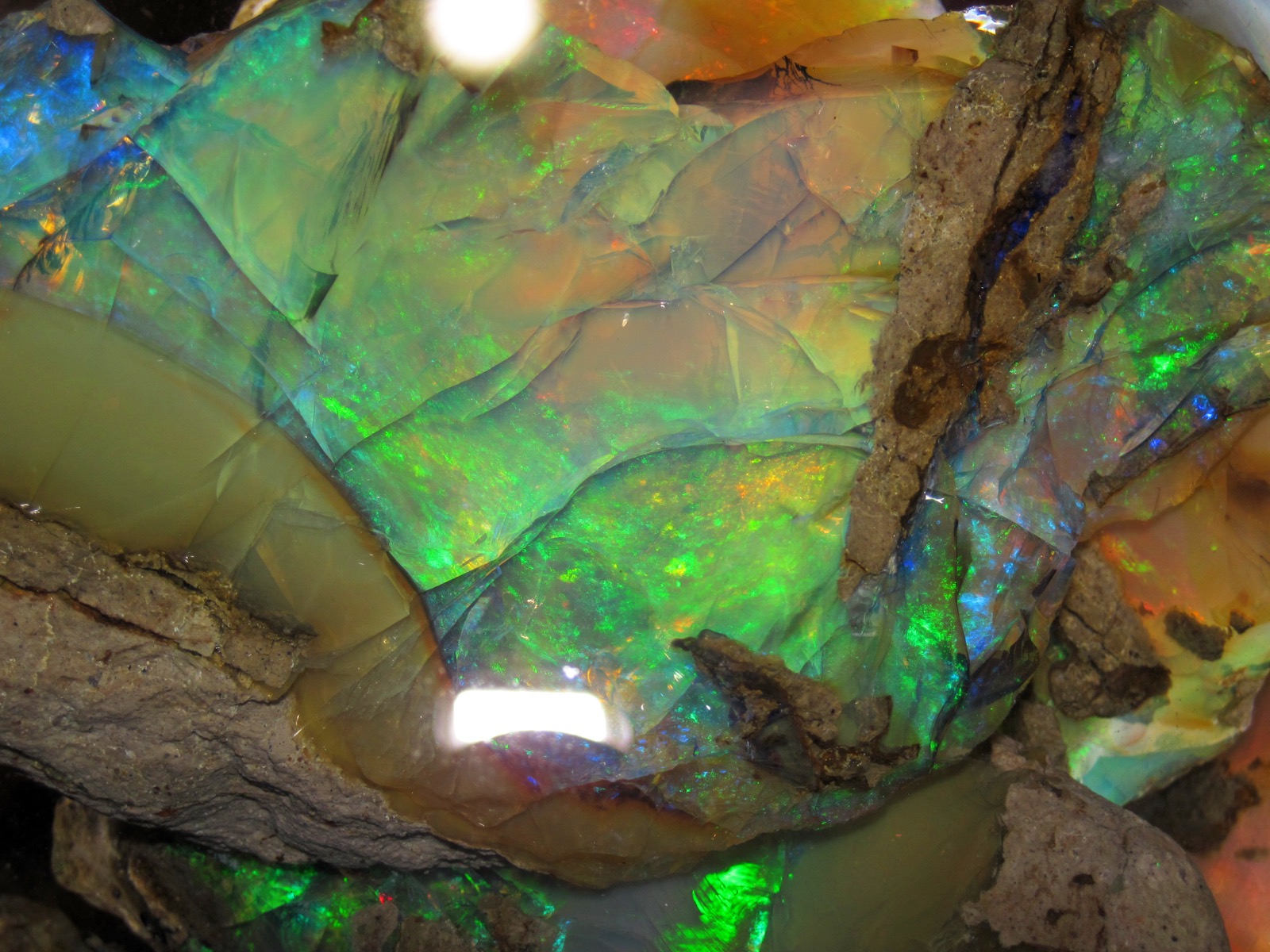
Rome already knew opal was unlike anything else. Pliny the Elder, writing in the first century, described a stone that carried the fire of other gems at once, the purple of amethyst, the sea-green of emerald, shining together in a union he found scarcely believable. What Rome could not know was why.
The answer waited nearly nineteen hundred years, until 1964, when J. V. Sanders and his colleagues at Australia’s CSIRO placed precious opal under an electron microscope and published what they saw in Nature: spheres of silica, each a few hundred nanometres across, stacked in ordered rows. The stone is a natural diffraction grating, its colour is not pigment but pure geometry, light divided by architecture too small to see.
It is fitting that the answer was Australian. A fourteen-year-old boy found opal at Coober Pedy in February 1915, on a camp at the edge of the Great Victoria Desert where the party had been prospecting for gold. Geoscience Australia still puts the country at ninety-five per cent of world supply, a figure the trade has questioned since Ethiopian production grew after 2008. The dial of Nº 10 holds that geometry in a slice barely thicker than paper: an ancient wonder, explained at last, and not diminished by the explanation.
In watchmakingOpal reaches the dial rarely and in very small numbers: Chopard in L’Heure du Diamant, Harry Winston in a Premier Hypnotic Opal Mosaic of eight pieces, Jaquet Droz in two unique Loving Butterfly Automatons of 2020. Rolex fits opal to the Day-Date 36, including the white-gold ref. 128239, though that is pink opal: common opal, colour without play of colour, a different material from the fire in this dial. No house publishes how its opal dials are built.
A note on the dial
Nº 10 is an opal doublet, not a solid opal disc, and we would rather say so here than have you find out at a service. Precious opal forms in thin seams, so a disc solid enough and wide enough for a dial is both scarce and expensive out of all proportion to the face you would actually see. A doublet takes that same colour bar and bonds it to a dark backing that carries the load and deepens the fire. The backing itself is not chosen yet: it will be black potch opal, ironstone or obsidian, and this page will name it once it is. Every hardstone dial is already a stone slice on a metal base plate. This one has one layer more, and we name it.
A note on care
A doublet has a bond line, and bond lines dislike standing water and heat. Do not swim or shower in this piece whatever the case is rated to, keep it away from ultrasonic baths, steam and solvents, and tell any watchmaker who opens it that the dial is a doublet before they touch it.