The story
The pattern no furnace can repeat
Long before anyone knew what it was, the Nama people of what is now Namibia were forging spearheads from a strange metal scattered across the veld. In 1836, Captain J. E. Alexander collected samples near the Fish River and sent them to London, where the astronomer John Herschel confirmed the material had come from space. It was the Gibeon meteorite: the shattered core of an asteroid, some 4.5 billion years old, strewn across one of the largest meteorite fields on Earth.
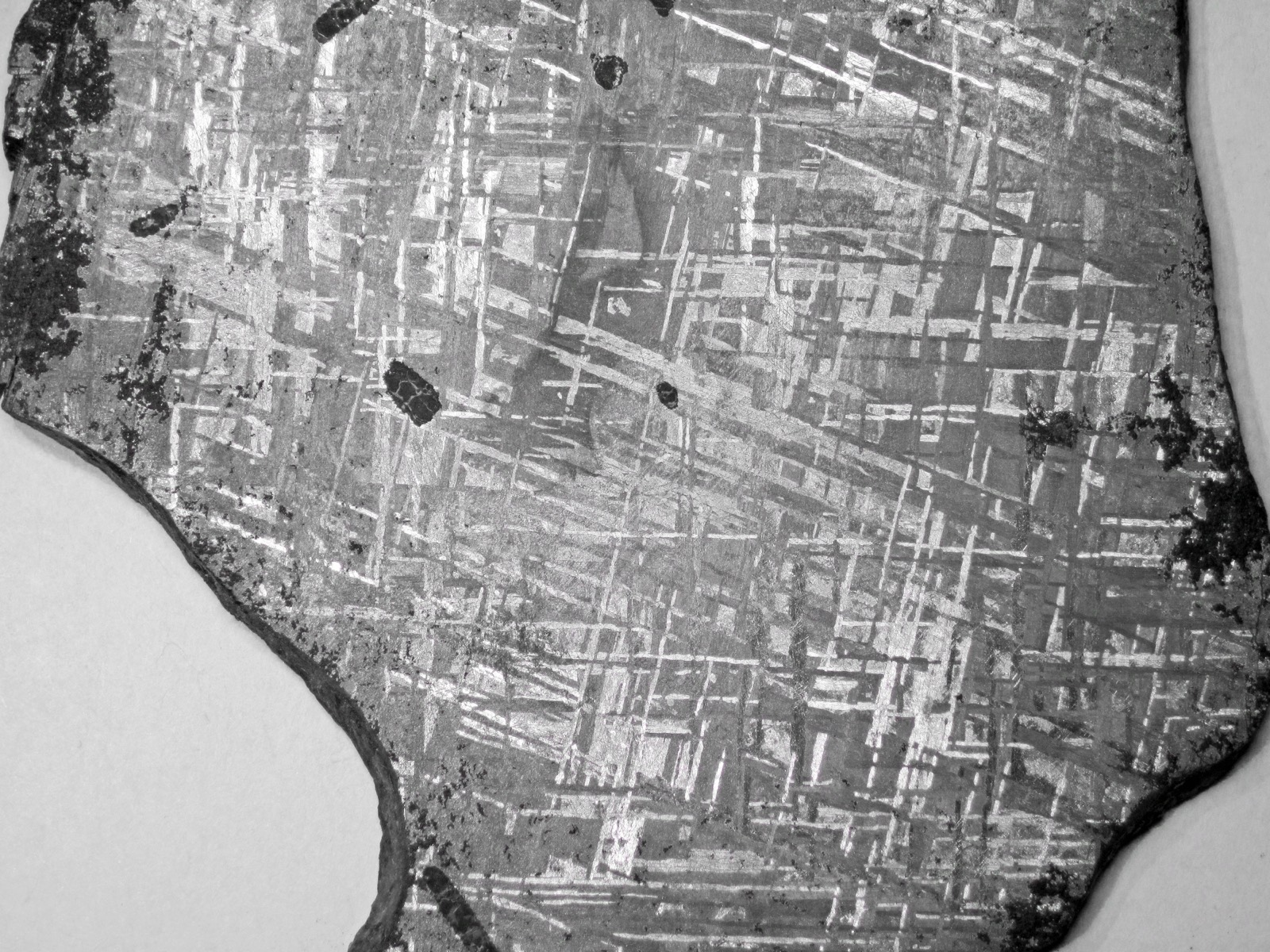
Slice it, polish it, pass it through acid, and it reveals the Widmanstätten pattern, interlocking bands of two nickel-iron alloys, named for Alois von Beckh Widmanstätten, who observed them in 1808. The pattern forms only where metal cooled inside an asteroid’s core over millions of years; no furnace on Earth can reproduce it, and no two slices repeat.
This is why iron meteorite became the quiet extravagance of the great dial makers. The dial of Nº 01 is cut from Muonionalusta, found at Kitkiöjärvi in northern Sweden in 1906, and lying in that ground for at least 800,000 years before anyone thought to pick it up. Each cut is the only one of its kind. HAS makes ten.
In watchmakingRolex has fitted meteorite dials to its most prestigious models in recent years, among them the Cosmograph Daytona, Day-Date and GMT-Master II; Rolex names no meteorite in its own copy, and the attribution to Gibeon comes from dealers rather than from Geneva. Omega named Gibeon for the Speedmaster Grey Side of the Moon “Meteorite” (2016) and moved to Muonionalusta for its 2024 Constellation dials. Jaeger-LeCoultre gave the Master Calendar a meteorite dial in 2015, described only as registered found in Sweden. Kurono Tokyo names Muonionalusta outright.
A note on the name
This piece was first listed as Gibeon, after the Namibian iron that drew us to the material. The dial is not Gibeon. Namibia has treated meteorites as State property since its National Heritage Act of 2004, in force from 2005, and Gibeon with a provenance we could evidence was not available to us. The dial is cut instead from Muonionalusta, an iron of the same class, and the piece now carries the name of its own source. The Gibeon story stays on this page, because it is the reason the piece exists.